
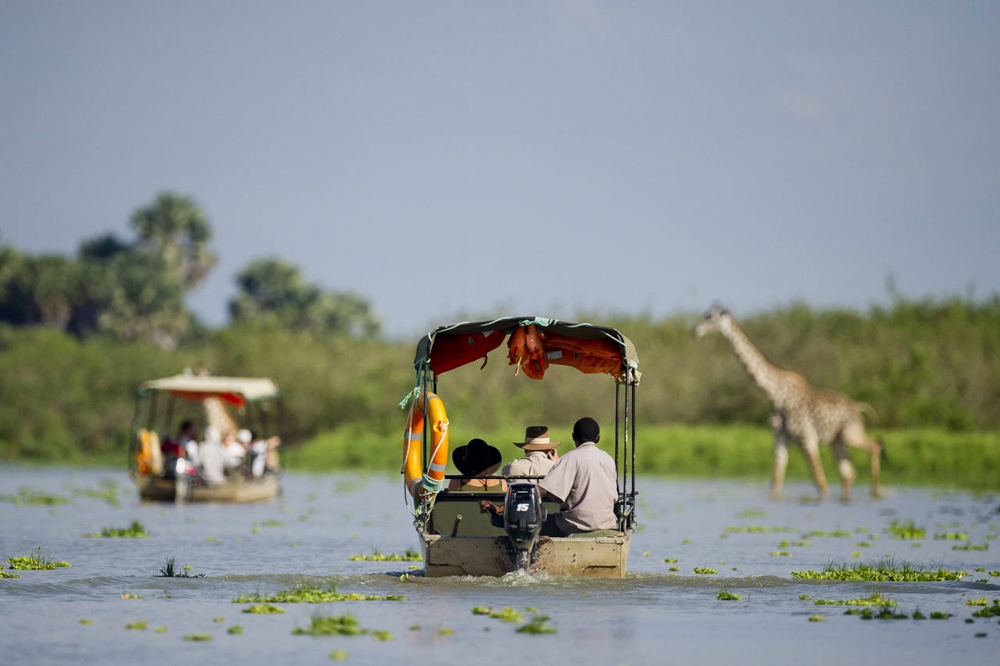
Nyerere National Park
Nyerere National Park is a 21,081 sq. mile park in southern Tanzania, the largest national park in the country. The park is home to one of the world’s largest wildlife sanctuaries. Safaris at the wider Selous ecosystem are renowned for their picturesque and pristine setting and the reserve itself was designated a UNESCO World Heritage Site in 1982 as a protected nature reserve.
More Destination Information
July is the start of the peak season for travelling to Tanzania. The migration is heading towards Kenya, and elephants are gathering at Tarangire National Park. Visitors can avoid the crowds and high season prices by visiting the more remote parks on the southern safari circuit, like Ruaha and Selous. Visitors are advised to book early to have their preferred choice of lodge. July is also a good time to visit Zanzibar, as it is a bit cooler than the December to March period, but still dry. Nights, evenings, and mornings can also be cooler on the mainland, so some warmer clothes should be taken for early morning safari drives and sundowners in the bush.
Dar es Salaam, meaning The Haven of Peace in Arabic, has one of the best deep natural harbours in the world. From a small Swahili town in the middle of the 19th century, Dar es Salaam has grown into a large metropolitan centre with a population of over 3,500,000 dwellers. The city population represents the over 120 tribes of Tanzania with their different cultural backgrounds coming together, alongside the oriental civilizations from the far and middle east, and the Europeans including early Portuguese visitors in the 16th Century, the Germans and later the British. All cultures at one time or another passed through Dar es Salaam. It is necessary to visit Dar es Salaam to understand the secret of letting different cultures live together in absolute harmony. Being the commercial capital of Tanzania, Dar es Salaam is also the main gateway to the nature reserves of southern Tanzania, which include the Selous Game Reserve and the National Parks of Mikumi, Ruaha and Udzungwa Mountains, Saadani and Kitulo. It also serves as a convenient connection for travel to the islands of Mafia, Zanzibar and Pemba both by sea and air. A city tour of Dar es Salaam will take you to the National Museum, Nyerere Cultural Centre, the Village Museum, Mwenge Wood Carvings Market, and the Magogoni Fish Market, among other interesting spots.
The wider Selous–Nyerere ecosystem is a 21,081 sq. mile park in southern Tanzania, the largest national park in the country. The park is home to one of the world’s largest wildlife sanctuaries. Safaris at Selous Game Reserve are renowned for their picturesque and pristine setting and the reserve itself was designated a UNESCO World Heritage Site in 1982 as a protected nature reserve.
Practical Information from the Supplied Travel Material
Tanzania Safari Accommodation
Home
Safaris
Tented camps suit clients who want to experience a truly authentic safari and immerse themselves in the wilderness. It offers you the change of seeing wildlife close by. The camps are in general smaller and more intimate than lodges. They are set in stunning locations with great game viewing. Don’t let the word ‘tent’ mislead you. Many tented camps are luxurious properties offering the same, or even better, comfort levels as the lodges. You can expect private spacious tents on decking platforms, with comfortable beds, furniture, flush toilets, en-suite bathrooms and sometimes a pool. Often they are more exclusive than lodges, which is the reason they sometimes cost more than a lodge. There are two types of tented camps: permanent and mobile. The permanent tented camps allow greater infrastructure and facilities, such as larger tents, more comfortable furnishings, flush toilets, 24-hour lighting and more staff. The advantage of mobile tented camps is that it allows guests to follow the wildlife and be as close to animals as possible.
Lodges are perfect for travellers who like comfort and ease and to sleep behind four solid walls. During the day you can enjoy game drives out in the bush and in the evenings all the facilities you would find in a hotel, like a swimming pool, bar, restaurant, gift shops and much more. Safari lodges are permanent facilities with solid walls made of brick and stone or other materials. In general, lodges are much bigger than tented camps. Of course, not all lodges are created equal and they have different levels of comfort and pricing. Most lodges consist of a number of buildings scattered across a plot of land.
Camping safaris in Tanzania are safaris for travelers who want to sleep under the stars shining from the African sky while listening to the sounds of wildlife in the wilderness. If you want to experience the Wild Africa in an authentic way, so therefore you should go for Camping safari. Just imagine being around the campfire in the wilderness as you zip one of your favorable Tanzanian beer and sweet morning songs from different species of birds alarming you to wake up thus getting ready for a new another day adventure. This trip will make you experience firsthand the magic African land, peoples’ norms and culture. Last but not least, camping safaris are a rewarding experience since you feel like you are roughing it and participating in a real African adventure..[...]
Practical Information from the Supplied Travel Material
When is the best time to go on an African safari?
Home
Safaris
One of the top questions travellers ask is ‘When is the best time for a safari in Tanzania?’ While there are definitely popular tourism seasons, other factors depend on one’s personal preference. Read on to discover your ideal season to visit Tanzania, based on your tastes and travel interests
The best season to visit Tanzania is during the long dry season, which falls from July to September. These are considered the best months for safaris, the Great Migration, trekking, and beach holidays in Zanzibar. Of course, these months are peak travel season. They will be busier, and some lodges, hotels, and parks will apply higher rates. If you prefer a more secluded experience, consider visiting during the short rainy season from the end of October to December. If possible, you'll want to avoid visiting during the long rainy season from March to May. The rains are often heavy and sudden, which can result in activities being cancelled last minute.
Other destinations may have traditional summer, winter, fall, and spring seasons, but Tanzania is situated near the equator and the Indian Ocean, meaning that its weather patterns are equatorial and tropical. There are two distinct seasons in Tanzania: wet and dry. The wet season is the rainy season, while the dry season is sunny and sometimes hot. Each season has its pros and cons, which are discussed further below.
When selecting your safari dates, keep in mind that Tanzania’s weather typically fits into these seasons, however, it is fairly common to experience sunny afternoons after a morning of rain during Tanzania’s wet season and occasionally rain during the dry season.
 WhatsApp